

Whether this is your first puppy, or you have welcomed multiple puppies into your home but it’s been a while, it is easy to overlook important safety considerations. Here are some things to think about. Keep in mind that while an initial thorough safety inspection is important, safety is a daily concern and puppies require constant vigilance!
To do a safety check go through each room in your house as well as your yard systematically looking for safety issues. Be sure to get a puppy’s eye view of your home. Our usual view of our homes and yards is from about 3-5 feet or more up, but the hazards puppies face are often much closer to the ground. Unless we get down to their level, we may easily overlook them.
- Look for things that can be harmful if chewed: electric outlets and cords, cables and phone cords. Electrical outlets can be protected with child proof covers. Unused electrical appliances can be unplugged. Cords need to be raised off the ground or passed through a piece of pvs conduit. There are commercial products designed to be placed over electrical cord that have an offensive small and taste (thereby discouraging chewing. Although the scent is not supposed to be significantly annoying to humans, the one time I tried this I could not stand to have it in my home – so buyer beware!
- Look for tipping hazards – things the puppy can pull or knock over on himself. As well consider if cords can allow him to pull something off a table onto himself, or cloths that can allow him to pull items off a table that may be harmful if chewed or eaten.
- Look for slip and fall hazards – open stairs and balustrades are especially risky for small puppies that can easily squeeze between
 treads or under / between bars of balustrades. Outdoors, raised decks can be a risk if puppy decides to jump off. Young puppies should not be allowed to go up and down stairs. There is convincing evidence that puppies 3 months and under who dog stairs have a higher risk of hip dysplasia. Unfortunately, the study did not evaluate risk of stairs beyond 3 months, so we do not know where the risk becomes negligible. In the absence of data to tell us when it is safe for puppies to do stairs, prudence would dictate keeping them off stairs well beyond 3 months – at least 6-8 months. If your puppy must do stairs, make sure it is on leash and under control.
 - Look for potential poisons – anything toxic to dogs should be well secured in an area the puppy cannot access. This includes medications, cleaning products, health and beauty products, sugarless gum and candy, toxic plants, rodenticides, antifreeze etc. Even products inside closed containers may not be safe as puppies are very good at chewing their way through containers. Childproof medication caps are not necessarily puppy proof.Sugarless gum & candy and chocolate are common causes of intoxication because we tend to leave things like gum packages in easily accessible places for our own convenience – on coffee tables, in coat pockets or purses, in the console in a vehicle.
- Look for suffocation hazards – such as plastic bags, chip bags etc. Chip and cereal bags have become one of the most common causes of suffocation for dogs. Puppies and older dogs should never be left unattended in the presence of chip bags (or similar) even for a brief period. See: https://www.preventivevet.com/pet-suffocation Safety is not just a one-time assessment but practicing good habits on a daily basis.
- Look for escape opportunities – doors that open onto an unfenced yard, gates that can be opened by the public, gates that have gaps between the fence and the gate that puppies can squeeze through, fences that do not go all the way to the ground, digging activity along fence lines.
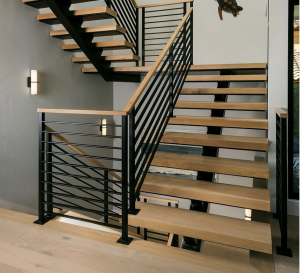 treads or under / between bars of balustrades. Outdoors, raised decks can be a risk if puppy decides to jump off. Young puppies should not be allowed to go up and down stairs. There is convincing evidence that puppies 3 months and under who dog stairs have a higher risk of hip dysplasia. Unfortunately, the study did not evaluate risk of stairs beyond 3 months, so we do not know where the risk becomes negligible. In the absence of data to tell us when it is safe for puppies to do stairs, prudence would dictate keeping them off stairs well beyond 3 months – at least 6-8 months. If your puppy must do stairs, make sure it is on leash and under control.
Practical Safety Habits
Start practicing good safety habits even before brining your puppy home so that they are second nature by the time you puppy arrives.
- Close cupboard and closet doors
- Close the toilet lid
- Keep shoes behind closed doors
- Hang up coats and put purses and back packs in a puppy proof location
- Find new homes for open storage containers (bins of craft supplies, yarn, childrens’, toys, cleaning supplies etc.)
- Be especially mindful of small items that can fall on the floor and be overlooked- sewing pins and needles, medications, paper clips, staples, hearing aid batteries.
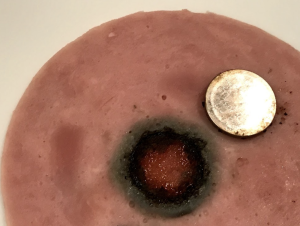
The damage done by a button battery in contact with a piece of ham for 90 minutes. https://www.hippocraticpost.com/first-aid/the-dangers-of-swallowing-things/ - Keep kitchen and bathroom garbage in dog proof / tip proof containers or behind cupboard doors.
- Keep all items with internal batteries (TV / sound system remotes, other remotes, hearing aids etc) in a secure location. Button batteries are especially dangerous as they are easy to overlook and easily swallowed.
- Escape proof doors and gates. A puppy fence, baby gate or tether point at a door can prevent puppies from dashing out when a door is opened. This is especially helpful if there are young children who may open the door without stopping to consider whether the puppy is loose.
- A secure containment area such as a Courtyard kennel or X pen is very helpful especially when you may be working with potentially dangerous items or cannot directly supervise your puppy.
Keeping puppies safe requires constant vigilance!